And so it would seem by the short time it was taught in class and the small amount of space describing it in the textbook.
What I Learned
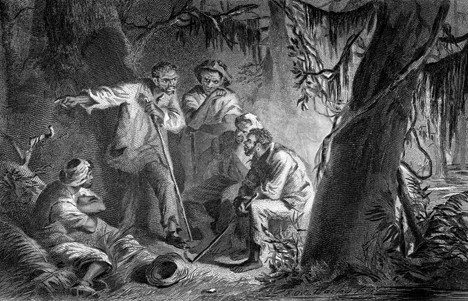
The short version is this: The slave Nat Turner, a preacher and self-proclaimed prophet, observed signs in the sky and said he experienced visions which he interpreted as calling him to eradicate slavery.
From August 21-22 in Southampton County, Virginia, he and his men killed 55 men, women, and children. Turner’s men were killed or detained within a few days. Nineteen were hanged. Twelve had their sentences commuted by the governor because of extenuating circumstances, such as their youth. Turner was captured on October 30 and hanged November 11.
The result of Turner’s actions was psychological terrorism of the local population and, to a lesser extent, to all communities with a significant number of black inhabitants. In response to Turner’s revolt, laws were passed that severely limited Negro rights.
Reviewing the Times
Everyone knew about successful events of rebellion on shipboard and in the Caribbean, one resulting in an African-American nation.
In the early 1830s, southern states were writing laws to protect slaves from misuse.
Blacks could be called as witnesses in some cases, but not to serve on juries.
Plantation owners did not expect “our people” to revolt against, much less murder, their master’s family. They counted on the slaves’ loyalty because of kind treatment. However, whites were keenly aware of how many more blacks there were, especially on plantations.
What Were the Results of Turner’s Revolt?
- An immediate backlash of whites killing blacks indiscriminately (about three dozen).
- Laws were enacted in southern states to restrict freedom of blacks.
- Lincoln would have known of this revolt and its failure. He was twenty-two, starting out on his own, and just dipping his toe into politics. He was born in Kentucky, lived in Indiana which was initially settled by Kentuckians, and later resided in Illinois, which territories were sympathetic to the slave states. Yet, Lincoln employed the same strategy in the Emancipation Proclamation!
Resources Available
I found very few resources, and not all of them were good.
The Confessions of Nat Turner, the Leader of the Late Insurrection in Southampton, Virginia is a written copy of Turner’s confession to the author, Gray. It is in too much detail to summarize here. Here are some questions I had:
- How do I know this confession was voluntary? Nat pleaded not guilty. The booklet contains a note that it is “as fully and voluntarily made to Thomas R. Gray in this prison where he [Turner] is confined, and acknowledge by him to be such when read before the Court of Southampton.” It is sealed by the Clerk of the District as deposited and “is a true copy from the record of the District Court.”
- Can I read the booklet for myself, and why didn’t my teacher assign the reading of this primary source? I cannot answer the second question. The booklet can be read at https://docsouth.unc.edu/neh/turner/turner.html .
- Is there proof that the confession was read to the court? Yes. In a statement by the six justices of the peace presiding as members of the court hearing the case of Nat Turner and verified by their seals on the document, they acknowledge that and also that he said he had no defense against the death sentence besides what he had told Mr. Gray. Furthermore, James Rochelle, Clerk of the County Court, placed his seal on the above document, testifying that these men were, indeed, members of the court trying Turner.
- Why did Turner plead not guilty yet also acknowledge his confession in court? Turner replied that he was pleading not guilty “because I did not feel so.”
- How much of the confession was edited, perhaps for clarity. In an author’s note, Gray states that he “published them, with little or no variation, from his own words.” This note was also under seal. In that case, Turner is a remarkably good speaker, quite believable from a preacher.
- What did Gray think of Turner? Is there a bias? In the same note as above, Gray describes Turner as a “gloomy fanatic” having a “dark, bewildered, and overwrought mind.” Could it be that Turner was mentally ill during the planning and execution of the revolt?
What did the firebrand pacifist Garrison think of the Nat Turner Revolt? According to “The Agitator” article by the National Endowment of the Arts, Garrison wrote,” I do not justify the slaves in their rebellion; yet I do not condemn them, and applaud similar conduct in white men.” https://www.neh.gov/humanities/2013/januaryfebruary/feature/the-agitator
A History of Racial Injustice includes a short article about Nat Turner. The trial is called “rushed.” I wonder if this source is biased.
- Was it? One guarantee of justice is a speedy trial. Secondly, evidence had been gathered about him from all of the trial of his co-conspirators. Thirdly, Turner had confessed in detail and acknowledged the confession in court. Fourth, there were no defense witnesses to call. Fifth, when asked why he confessed and yet pled not guilty, Turner’s answer was because he did not feel guilty. It is possible to have a rapid trial that is just.
- “Conditions of enslavement worsened for thousands of enslaved Black people as more cruel, barbaric, and traumatizing forms of control were implemented.” Considering that laws were going on the books in southern states to prevent actual cruelty to slaves, this is a distorted statement.
“Nat Turner’s Rebellion: Horrific or Heroic?” on America’s Black Holocaust Museum is a much better article because of its frequent references. However, the wording is very biased, as well as the refusal to consider more than one option. See what you think: https://www.abhmuseum.org/nat-turners-rebellion-horrific-or-herotic
- Turner was literate. Why didn’t he write his own confession? Good question. Maybe he was on suicide preventions and not allowed sharp pens and pencils. Maybe it was because Turner knew he had no connections to publishers. I don’t know. Nobody asked him.
- Gray transcribed and published the confession because he was in debt and knew the booklet would sell. So? That does not mean it is not reliable.
“Nat Turner’s Revolt (1831) by Encyclopedia Virginia is a very good overview of the revolt, although much is from Confessions of Nat Turner. In its words, the article is sometimes biased, such as calling Turner a “self-styled” prophet, however it’s overall good. https://encyclopediavirginia.org./entries/turners-revolt-nat-1831
- Was there any other reason that Turner revolted? This article suggests an interesting, although unsupported, option. “In February 1831, just days before Turner approached his future conspirators, Reese’s son John W. signed a note the put Turner’s son up as collateral for a debt that he, Reese had struggled to pay.”
So, that’s what we know. What do you think is the truth?