Categories
History

American Slavery: the European Invasion

The first and second waves of Eurasian immigrants resulted in the First Nations. The first invasion came into Alaska and worked its way down the west coast, deserts and mountains. The second wave came over the Atlantic Ocean and has been found as far west as Minnesota. Both of these originated in Turkey and the Baltic nations, but DNA differs enough to track them. It is possible that these immigrants brought the practice of slavery with them.

As far as we know, the next arrivals were the Vikings. Leif Ericson is said to have followed the directives of Icelanders who had sailed west far enough to spot land, but then returned. If this was during the last ice age, as some hypothesize, the Vikings could also have been directed by sailing south of the ice and by consulting their “sunstones.” https://phys.org/news/2011-11-viking-sunstone-myth.html

We know that Vikings dealt in slavery because slave markets have been found, including a large, active one in Ireland. But if they meant to enslave the Americans, they probably quickly determined that negotiation was the best policy. The Vikings were vastly outnumbered. Their widespread villages did not survive.

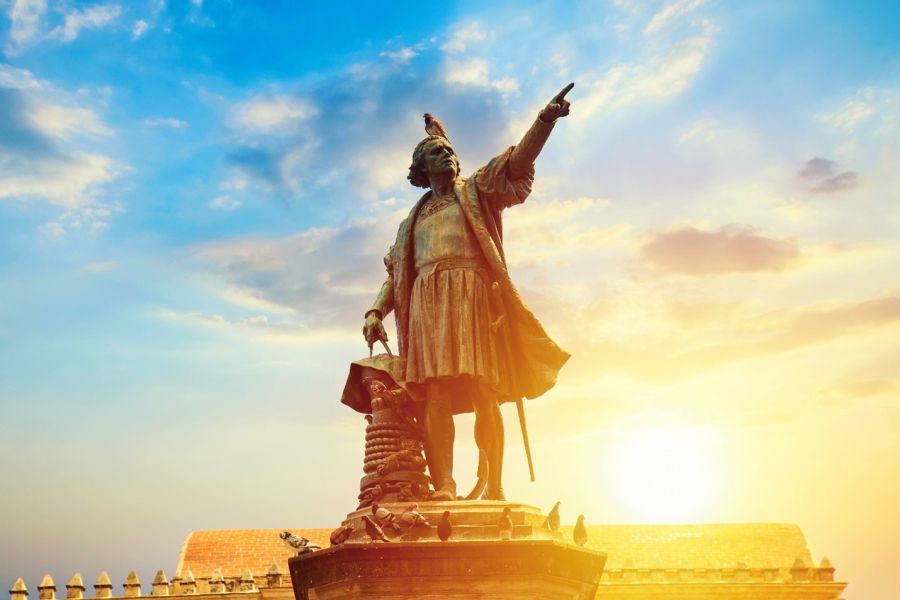
We think Christopher Columbus arrived next. Ferdinand and Isabella, his sponsors, were very clear: the inhabitants were to be Christianized and remain free. Columbus was under the authority of the crown, as would be all native inhabitants. Later the monarchs amended the instructions so colonists could require labor and tribute, supposedly to correct reported laziness.

But greed got the better of Columbus. When the king and queen heard of his enslaving and mistreating the Native Americans, they sent a ship to relieve Columbus of his governorship and bring him back in chains.

It was this protection of native inhabitants that forced European colonists to turn to Africa for slaves. They were not the first choice. So much for the anti-black racist argument of slavery.
Categories
History

Ancient and Pre-Columbian American Slavery

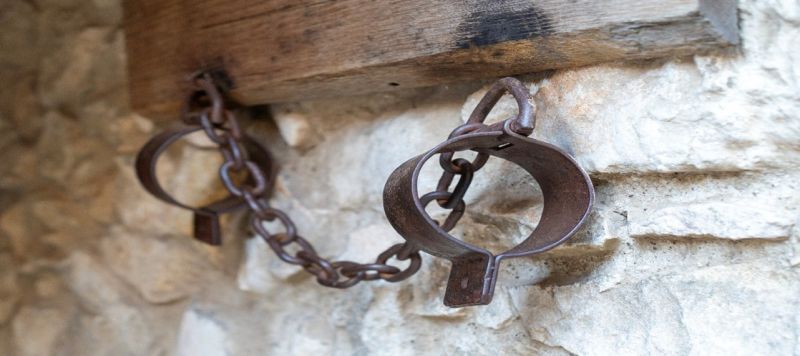
manacles

What is slavery? A slave was someone who was owned by another person entirely. Not only was that person considered to be property, but he or she also had no rights at all. Nada. Zip. The slave didn’t even have the right to life. Slavery has been around for a long time and continues to exist today in some nations.

When asked “When did slavery begin?” many people will say it has always been part of human history.

I disagree. Whether you believe in evolution or intelligent design, the human race is traced back to an original family. It is highly unlikely that slavery existed in tight family groups because slavery always enslaves someone who is an “other.”

Even when a group came into an area looking for supplies of obsidian, there does not seem to have been a war, but the groups worked together, although not always equally. It seems that the directing group had more advanced knowledge and arrived later.

There is one early cave drawing that shows two groups of armed men approaching each other. This has been interpreted as a battle scene. However, since we now have proof that man and megafauna lived at the same time (overprinted footprints, spear and arrow heads imbedded in megafauna bones), the picture could just as well be interpreted as a friendly meeting by two groups who always went armed for protection against animals.

When people began to construct city states and enormous structures such as monolithic stone circles (such as Stonehenge, which was not the first), we see suggestions of labor division with overseers and hierarchy, but we don’t know the labor structure.

The earliest mention of slavery that I have found was in the time of Sargon the Great. Some Bible scholars equate him with Nimrod mentioned in Genesis chapter 10. If so, he is described as “a great hunter before the Lord.” Considering the megafauna wandering around, that is saying something!

Jewish lore says Nimrod was a “ruthless leader,” a “merciless ruler,” and the “chief idolater.” Could it be that he believed his own press clippings and morphed into Sargon, who may have been the first to “hunt” men (in terms of warfare, not murder). Someone had to be the first to attack his neighbors.

Sargon conquered an enormous swath of land before he was stopped at the mountain passes of Turkey. We hail him as a great warrior. But if he was first, he attacked people who until then were ignorant of murder on a large scale. He wasn’t great. This was easy pickings. And it was immoral.

Once slavery was conceived, it spread across all of the earth, most likely through trading routes. Only one person successfully stopped it. A Chinese emperor abolished it. But after his death, that was reversed. After all, by now, slavery was considered normal. Indeed, since the definition of normal is “what most people are thinking or doing,” it was normal.

Meanwhile in the western hemisphere many, but far from all, nations and empires adopted slavery. This included nations in the area that today is the United States of America.

Categories
History

Exposing Biased Civil War Sources

words matter

How do we know that a source is trustworthy?

First, by research the author: his or her education, other books written by this author, awards received, historical knowledge specialty, and what organizations the author joins or supports. Obviously, if the author is a member of the Ku Klux Klan or an activist lawyer for black civil rights, you would read carefully, looking for bias. Nevertheless, the book may still be enlightening!

Examine the bibliography. How extensive is it? How much variety does it contain? Are the sources reliable (as far as can be determined)? Is there a mix of sources from the 1860s and 1870s or are they all secondary sources?

Look at the vocabulary of the book. Careless disregard for the meaning of a word or phrase may actually hide bias.

In Civil War history, a few inaccurate words must be used for clarity. “Civil War” is the most common. Even Southerners use it when speaking to the rest of us because we are not familiar with “Lincoln’s War” or the “War of Northern Aggression.”

But a Civil War is conflict within a nation. That outright denies the claim that the Confederate States of America comprised a separate nation.

Union is often used incorrectly. A union is a voluntary association or organization of people striving to reach mutual goals. Note the word voluntary. Teachers associations for mutual goals where membership is forced is not a union, regardless of their legal names. In Right to Work states, teachers organizations are, in fact, unions.

When the Confederate states left the USA, they formed a separate union. The USA union altered substance to contain only the remaining voluntary states. It was incorrect to say that war was waged “to restore the Union” because war is force, and therefore not voluntary. Nor could war “save the Union.” That Union was already altered. Even when Confederate states were “readmitted to the Union,” it wasn’t true because southerners didn’t want to associate with the north. Legislation passed because almost no prior Confederate whites had voting rights, and the national Congress was completely Republican.

One more example is to use “federals” for USA troops. Federal refers to a national government, as opposed to state governments. While it is true that the USA had both national and state troops, and the national troops could also be called federal troops, the CSA also had federal troops and state militia.

Read carefully. See if words are used correctly and carefully. If not, you must determine if the author is biased, is deceiving the reader with propaganda, or just sloppy. (In which case, what else will the author sloppy with?)

Words matter.

In conclusion, read a wide variety of opinions and approaches to history, but be careful to identify bias and propaganda for what it is.

Categories
History

Civil War Lies

As a high school student, I found history interesting, but history teachers boring. Lincoln was my favorite president after George Washington. I believed everything I had been taught in class or had seen on television.

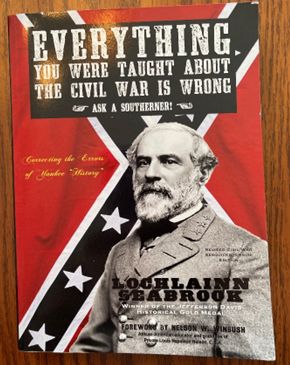
Ten years ago, I found this book:

Everything You Were Taught About the Civil War Is WrongI was not afraid that it would upset my beliefs, and I enjoyed learning other points of view, so I investigated it. The Table of Contents was shocking, if true. The bibliography was extensive: 20 pages of tiny print! There were many southern sources. I had rarely seen southern sources in other history books.

The author had been awarded the Jefferson Davis Historical Gold Medal.

Looking at ratings, I saw they were abysmal, so I looked at comments. They were all rabidly negative. Foaming at the mouth negative. Knowing that nothing is all bad or all good, I recognized a smear campaign. Today, we would call it Cancel Culture.

The smear campaign really stoked my curiosity. I bought the book.

When I read it, I was shocked.

I have fact checked most of the claims in this book and found them to be true. Actually, in some cases, the full truth was even more unpalatable.

They lied to us. But who did it?

As a teacher, I knew that unless you are teaching an area of expertise, you have to trust the book. You don’t have time to do your own fact checking. You expect that the writers have done their job.

As a professional writer, I know that textbooks are usually ghost written, because the “authors” don’t write at a professional level. The ghost writer’s specialty is writing, not the book’s subject. So the writer didn’t lie to us.

The listed authors should be experts related to the book’s subject. Did they lie to us? Lying is such a strong word! It includes untruth, but also the intention to deceive. I don’t think that of the authors. But then they must be ignorant, lazy, or lacking in curiosity. Because the truth is out there. I found it, and I am a self-taught historian, not a professional.

Then who lied to us? Who would gain by a massive propaganda campaign?

You’re not going to like the answer: the Lincoln administration and the nineteenth century Republican Party.