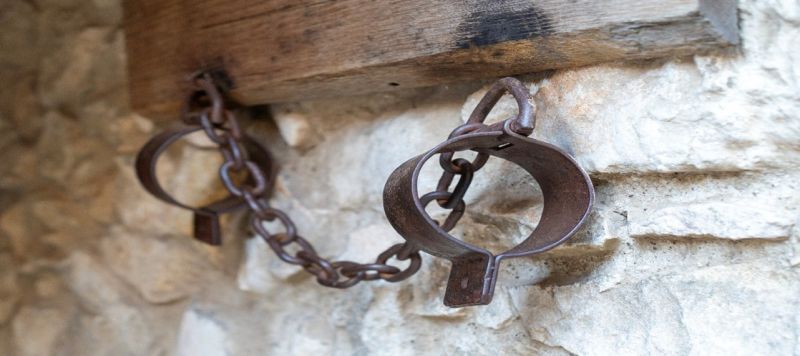
What is slavery? A slave was someone who was owned by another person entirely. Not only was that person considered to be property, but he or she also had no rights at all. Nada. Zip. The slave didn’t even have the right to life. Slavery has been around for a long time and continues to exist today in some nations.
When asked “When did slavery begin?” many people will say it has always been part of human history.
I disagree. Whether you believe in evolution or intelligent design, the human race is traced back to an original family. It is highly unlikely that slavery existed in tight family groups because slavery always enslaves someone who is an “other.”
Even when a group came into an area looking for supplies of obsidian, there does not seem to have been a war, but the groups worked together, although not always equally. It seems that the directing group had more advanced knowledge and arrived later.
There is one early cave drawing that shows two groups of armed men approaching each other. This has been interpreted as a battle scene. However, since we now have proof that man and megafauna lived at the same time (overprinted footprints, spear and arrow heads imbedded in megafauna bones), the picture could just as well be interpreted as a friendly meeting by two groups who always went armed for protection against animals.
When people began to construct city states and enormous structures such as monolithic stone circles (such as Stonehenge, which was not the first), we see suggestions of labor division with overseers and hierarchy, but we don’t know the labor structure.
The earliest mention of slavery that I have found was in the time of Sargon the Great. Some Bible scholars equate him with Nimrod mentioned in Genesis chapter 10. If so, he is described as “a great hunter before the Lord.” Considering the megafauna wandering around, that is saying something!
Jewish lore says Nimrod was a “ruthless leader,” a “merciless ruler,” and the “chief idolater.” Could it be that he believed his own press clippings and morphed into Sargon, who may have been the first to “hunt” men (in terms of warfare, not murder). Someone had to be the first to attack his neighbors.
Sargon conquered an enormous swath of land before he was stopped at the mountain passes of Turkey. We hail him as a great warrior. But if he was first, he attacked people who until then were ignorant of murder on a large scale. He wasn’t great. This was easy pickings. And it was immoral.
Once slavery was conceived, it spread across all of the earth, most likely through trading routes. Only one person successfully stopped it. A Chinese emperor abolished it. But after his death, that was reversed. After all, by now, slavery was considered normal. Indeed, since the definition of normal is “what most people are thinking or doing,” it was normal.
Meanwhile in the western hemisphere many, but far from all, nations and empires adopted slavery. This included nations in the area that today is the United States of America.