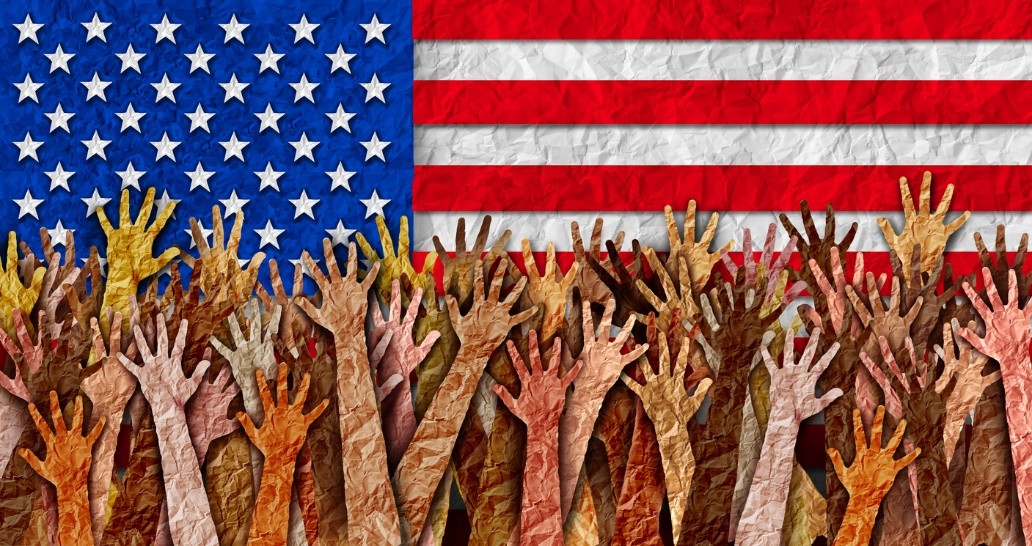
There is a great difference of opinion about what the founding fathers meant by this. Did they mean whites are created equal? Or white men, but not women, are created equal? Or did they mean all mankind, regardless of sex and race, is created equal?
Now we know that everyone was not treated equal. We can agree on that.
But what did the phrase mean? We have to look at facts.
- Linguistically, “men” and “mankind” were used to include all humans, as well as the more restricted usage of male humans. This was true until recent years. In neither case, was the usage restricted to whites.
- Women were active patriots. They did not act as second rank citizens. Abigail Adams exemplifies this in her letter to her husband John Adams wherein she encourages him to “remember the ladies.”
- We have to be careful to separate states during the Revolutionary War from the same states during the Civil War. We must stick to the facts.
For instance, three New England states voted for slavery before the first future Confederate state.
Although the south had become the center of plantation business, New England was and would continue to be the hub of the shipbuilding and slavery trades. In fact, Delaware would enter the Civil War as a slave state.
The proof of the difference is what actually happened within the states. The phrase “all men are created equal” already existed in a state constitution: that of Virginia. Yes, Virginia.
The immediate result of the acceptance of this phrase was that during the first twenty years of the USA, tens of thousands of slaves were set free. And Virginia, who freed 10,000 slaves, emancipated more than all other states together.
The reason we look at the first twenty years is because it gave masters time to adjust their lives and businesses to run without slaves, and—just as important—it worked as a period of apprenticeship during which slaves learned trade and economic skills necessary for independent living. After all, there was no free child care, free medical care, free clothes, free food, free care for the elderly and the infirm, free funeral care, and no assured employment.
- It is often mentioned that Jefferson wrote the document, and he owned slaves. First, Jefferson was chosen to write the document because he was the best writer, not because of his ethics. The document was a summary of decisions and supporting thoughts of the whole conference. Second, the document had to be written in such a way that all thirteen states would sign it. Third, Jefferson was a very conflicted person. His morals and ethics did not agree. We can see this in the section he wrote against slavery that was omitted in the final version as unsignable.
- One of the great impacts on colonial America was the Enlightenment Philosophy, which stressed such items as scientific inquiry, progress, and the rights of man. The American colonists, who were generally more educated as a whole than we are today, discussed these topics, and they are seen in the document. A constitutional republic with its self-rule was progress from traditional monarchies. The Constitution would eventually contain the Bill of Rights. It was the abridgement of these rights of the people that caused the Revolutionary War.
- The Christian faith, mostly Protestant but with a significant Catholic presence, affected every household, and it was an active faith, not like today, or like Britain of that time. All colonials learned to read so they could read whatever holy books their faith allowed. All Protestant homes had a copy of the King James version of the Bible, and usually also Pilgrim’s Progress and the Book of Martyrs. Catholics had their missal and often Lives of the Saints.
I make a big deal of this because the document included the phrase “are created.” Created means to be made from nothing, which is definitely not an enlightenment idea. It supports the “intelligent design” theory, although the “evolutionary process” theory was still in the future. And it says “are” meaning that at the day of the document that was still true and was seen as being true in the future.
When I read the word Providence in works of that time, it always refers to the Judeo-Christian God. Remembering that all colonists would need to vote on this eventually, and their representative would need to join an unanimously approval in conference, there is no other way to interpret the word Providence.
The concept of man created by God is the basis of “inalienable rights.” They are inalienable because they come from God, not the government. Especially, not King George III.
God created one man and one woman, according to the Genesis account. In them was the DNA to create the variety of races seen today. Therefore, all are equal. Woman was a “helper meet” for Adam, created from his rib, not his skull or his feet. She was created equal and her job is to “complete” her man. Therefore, equality between the sexes is ongoing. (The concept of male head of house and church is a separate issue, dealing with God’s ongoing use of living samples, not innate qualities and abilities.)
- Christianity and the Enlightenment are not natural opponents. Indeed, many easily believed in both. And then there were radicals such as Jefferson who believed they could not co-exist, and his personal version of the Bible proved that he chose Enlightenment over Christianity.
Because they are not opponents, they could claim a created man and also believe in self-government (which is the original government of the Bible) and in progress.
- Because of all of this, the best understanding of “all men are created equal” is that that fact already existed, but the current governments needed to progress (actually regress) so reality among mankind met the American Dream of equality (not equity!) of races and sexes. That is, progress would make earthly reality equal heavenly reality.